
By Kylie Marsh
Kylie.marsh@triangletribune.com
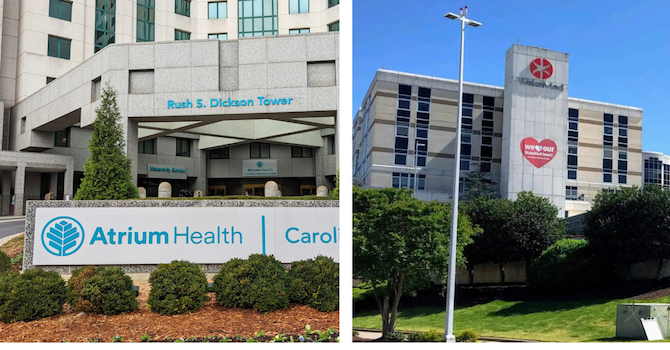
RALEIGH – A planned merger between WakeMed and Atrium Health has Raleigh residents concerned.
A town hall at St. Ambrose Episcopal Church Monday evening drew patients, county commissioners and WakeMed employees who raised numerous concerns about oversight and transparency, the threat of rising healthcare costs and a decline in quality of care.
WakeMed released a statement in May about the “strategic merger,” which argues it will add a $2 billion investment to Wake County and more than 3,300 new jobs, allowing an expansion of services to over 1 million patients. This would equate to an expansion of beds and facilities, financial assistance available to patients, and expanding workforce development.
The Patients Union is a new national organization with the goal of advocating for patients and assisting with navigating America’s complex for-profit healthcare system. TPU hosted Monday’s town hall, asking attendees to answer two questions on index cards: What makes WakeMed worth saving? What question do they have about the proposed merger?
Rob Stephens is the directing organizer of The Patients Union, a member of the Men of Southeast Raleigh and a member of the executive committee of the Raleigh-Apex NAACP. “Hospitals and healthcare is a big business,” Stephens said. “Because we have shifted healthcare in this country to being about helping people and where the first, second and third priority is the bottom line.”
The Reverend Hershey Mallette Stephens shared her experience with life-threatening postpartum preeclampsia, a pulmonary embolism and heart failure, which are among the leading causes of maternal mortality in the United States. The condition disproportionately affects Black mothers. Mallette Stephens said WakeMed gave her life-saving care, whereas another hospital dismissed her concerns and discharged her. “They listened to me. They believed me, and they acted,” she said. “WakeMed saw me. WakeMed treated me. WakeMed saved my life.”
Other community members shared their personal experiences with WakeMed, which has received countless awards. Last year, it became the first hospital in the state, and one among only 47 worldwide, to earn Magnet Recognition with Distinction, a designation of global leadership for nursing.
“Those aren’t just plaques in the hallway when you walk in the hospital, they’re evidence of choices,” Mallette Stephens said. “Choices to invest in nurses, choices to invest in mothers, choices to invest in children, choices to invest in healing.”
Rebecca Cerese, director of the North Carolina Justice Center’s Health Advocacy project, said the merger “threatens the economic security” of Wake County. In 2024, Advocate Health cancelled liens against patients for medical debt following the merger with Atrium. Between 2017-22, Atrium sued patients for medical debt 2,482 times, more than any other hospital system in the state, Cerese said, accounting for over 40% of all medical debt lawsuits in North Carolina.
“Atrium has since stopped these cruel practices, but there is no law on the books stopping them from going back to that practice,” Cerese said.
WakeMed opened in Southeast Raleigh in 1961 after St. Agnes Hospital, the city’s hospital that served Black patients, was closed that year. Atrium Health’s parent corporation was formed by a merger with Advocate Health, a Charlotte-based nonprofit healthcare system. Advocate Health is among the top 5 largest nonprofit healthcare systems in the United States, with a new patient revenue of $26.9 billion.
Other community members demanded transparency regarding organizational structure and veto power between Atrium and WakeMed under the terms of the merger. The Charlotte-Mecklenburg Hospital Authority is a governing board of Atrium Health. The chair of the Mecklenburg County Board of Commissioners can veto or approve nominations but cannot nominate on their own.
Cerese said Atrium Health was awarded land and subsidies to build a medical school in Charlotte’s historically Black Brooklyn neighborhood which was razed during urban renewal. “They promised the community they would include a lot of affordable housing. Three years later, that housing has still not materialized,” she said.
Harold Malette, community outreach and education coordinator of the Men of Southeast Raleigh and a Southeast Raleigh native, raised concerns about the quality of care available under the purview of Atrium Health’s leadership.
“Our concerns are related to property, health and safety in our community,” he said. “We all know our community has had a longstanding disparity with healthcare, with property taxes and also with safety.”
Nathan Foster, a health policy specialist with the North Carolina Justice Center, said Advocate Health charges some of the country’s highest prices to commercial health insurers in the country, at 318% of Medicare rates.
“Out of the 15 largest healthcare systems in the country, only two of them have higher-than-average prices,” Foster said, including Advocate Health. “The State Employees’ Health Plan, which covers state employees and their families, has stated that they pay Atrium anywhere between 15 and 40% more than what they pay for the exact same care.”
Raleigh-Apex NAACP President Kelli Wilhelm also asked for transparency. “The Black community has learned the hard way that promises are too easily broken,” she said. “We need written guarantees that will address our concerns about health costs, that will address our concerns about local control.”
During the audience portion to discuss their questions and concerns, many attendees did not read what they wrote on their index cards despite being repeatedly asked to do so.
One attendee said he’s worked as a nurse for over a decade, including both at Atrium Health and WakeMed. “WakeMed doesn’t kill patients. Atrium kills patients. I’ve worked at both. Atrium is among the most unsafe hospitals I’ve ever worked at,” he said, adding his concern is that there is even a deal at all. “You can look at the deal. It doesn’t matter what the details are, because Atrium will kill you.”
When WakeMed CEO Donald Gentzig was invited to speak, decorum was lost to exchanges between Gentzig and audience members. “We’re not perfect. We haven’t saved every life. We’ve lost a lot,” Gentzig said. “This is about making sure that we are able to deliver care for more and more people that are moving to our community.”
Gentzig said Atrium saves a lot of lives as well, to which a nurse responded by giving him the finger.
Wake County Commissioners are due to vote on the contract in August following a 90-day delay that was intended to “provide the space and time for all to gain a full understanding of the tremendous impact and value this combination will bring,” according to WakeMed’s May statement.
