
By Kylie Marsh
Kylie.marsh@triangletribune.com
“I’m tired of our history being murals that can be painted over.”
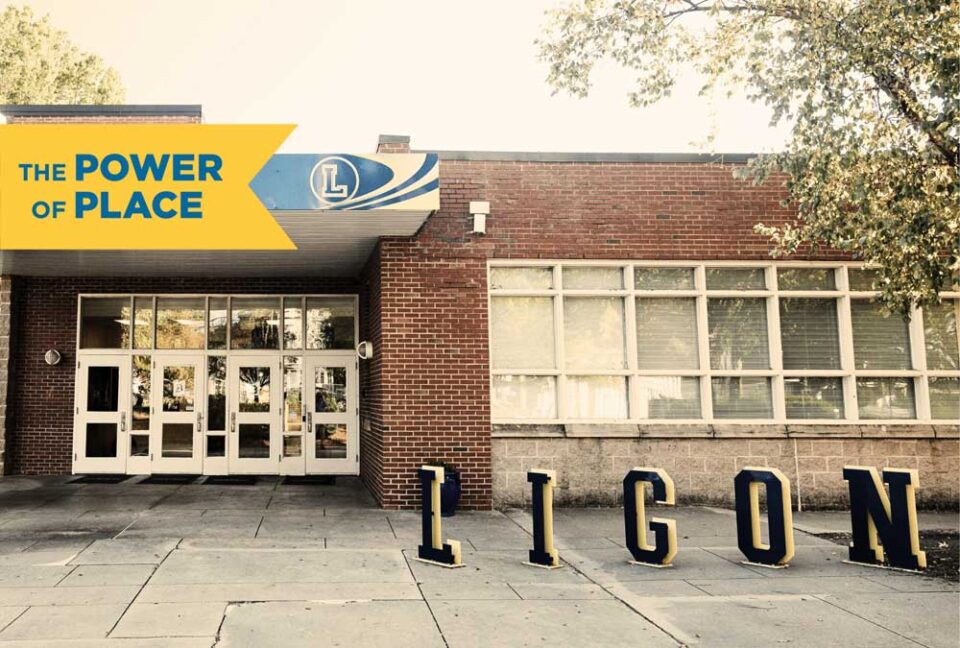
The decision to tear down a historically Black school in Southeast Raleigh has damaged trust between locals and elected officials.
Despite public opposition, the Wake County Public School Board decided in March to demolish J.W. Ligon Magnet Middle School. The school was previously John W. Ligon Junior-Senior High School before becoming a junior high school after it was desegregated in 1971.
The WCPSS decision reflects the contrast between current and future students and its alumni – two groups that look very different. The current Ligon School building does not meet standards set by the North Carolina Department of Public Instruction, WCPSS Superintendent Robert Taylor said during a work session.
Many “Little Blues” and community members from the surrounding Black neighborhoods expressed dissatisfaction with the decision. “There is a continuing sense of distrust,” SE Raleigh resident and historic author Carmen Cauthen told The Tribune. “There is a sense of frustration, especially in this particular era, when we see so much of the political leadership dismantling the history of our country.”
In November, alumni, parents, and public officials were presented with three options: renovate the existing building; completely demolish and build a new building; physically move the old building to make way for a new facility, then demolish the old one.
Cauthen delivered a short presentation on the historical significance of the school during the November meeting. Although she did not attend Ligon, she grew up in the community and attended school events.
During the March work session, which preceded a vote to demolish the school for an upgraded facility, staff presented the results of several community engagements, including emails, in-person meetings and listening sessions, and virtual meetings.
Most participants of the digital survey identified as white, 9% Black and 29% preferred not to say. Sixty-nine percent were current parents and 19% were alumni, but there was no differentiation between the high school alumni or the middle school alumni. The majority of public engagement gleaned that minimizing the disruption and maintaining educational excellence were the top community priorities, with historical preservation of Ligon’s legacy following behind.
The school sits on a hill, affectionately looked upon as a beacon of educational opportunity within the community, alumna Lonette Williams told The Tribune.
“‘A beacon on the hill’ is how we always referred to Ligon,” Williams said. She calls the decision an “atrocity,” saying the process through which the school board made the decision lacked transparency, fairness and due diligence.
“They made no attempt at any time to show us possible plans where they could do what we were asking them to do. They had no intent,” she said. Williams attended the November meeting, and says the proposal to rebuild the school at “the bottoms,” a muddy hill where children used to ride down on cardboard sleds, was decided from “Day One.”
Cauthen’s comments echoed Williams’, as well as by school board member Toshiba Rice. “I am deeply concerned with what has gone forth and the fact that we’re not choosing to honor a space that people in the community that lives there is asking for,” Rice said during the work session. ”They asked for one simple thing. They understood that a new building would have to take place. But they asked that it would stay at the top of the hill. They compromised with that. They didn’t want the building to be torn down from the beginning of talks.”
Board member Chris Haggerty said LS3P, the architecture firm assigned to Ligon, built a similar project for West Charlotte High School, another historically Black public high school.
“They gave our state school board association a presentation that detailed everything in terms of historical research, cultural outreach, and all the work they did to preserve the history of that school,” Haggerty said. “None of that took place here.”
Haggerty said an LS3P representative has been untruthful about its presentation. “I have a lot of concerns about the process that has gone on here to date. I worry about being brought selective facts and selected information to build a case toward a preferred outcome.”
(Read the entire article on our website.)
