
By Yasmine Regester
Peacemaker Staff Writer
Black business owners say they are already losing contracts and struggling to meet payroll after North Carolina eliminated the office that helped minority- and women-owned companies compete for government work.
Now, a statewide coalition of business and civil rights organizations is urging Gov. Josh Stein to act quickly to restore that support, potentially through an executive order reestablishing the state’s Historically Underutilized Businesses (HUB) program.
“This means payroll isn’t getting paid on time,” said Calvin Stevens Jr., a contractor, president of CATE Services and longtime member of the former HUB Advisory Council.
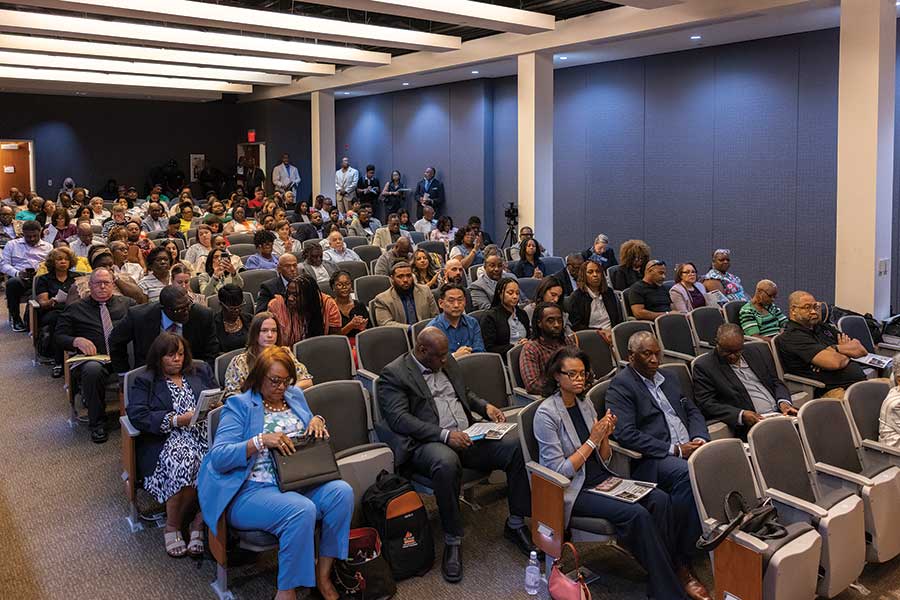
Stevens was among the business owners and advocates who gathered on September 10 at the International Civil Rights Center & Museum in Greensboro for a statewide business leadership summit and town hall examining the consequences of the HUB office’s closure.
Some owners said they have lost contracts since the office was abolished, while others expressed concern that they must now compete against much larger corporations without the assistance, certification and contracting goals previously provided through the HUB program.
The event was organized by “The Collective,” a coalition that includes the Greensboro Business League, Greater Durham Black Chamber of Commerce, N.C. Black Alliance, Urban League Affiliates of North Carolina and the NAACP North Carolina State Conference.
The coalition is calling on Stein to issue an executive order establishing a Governor’s Advisory Council on Black Affairs, accelerating the transition of former HUB businesses into the state’s Small Business Enterprise program, and creating a modernized program with a 25 percent participation goal and clearly defined good-faith requirements.
“We’re here to talk about solutions, recommendations, and next steps,” said Gerry McCants, co-founder of the Greensboro Business League. “We also have an executive order and a resolution that speaks to some of the things that we talked about today that we hope the governor’s office will do.”
The push comes two months after Senate Bill 257, the state’s 2026 budget, became law July 7. The legislation immediately abolished the HUB office and eliminated its programs and services.
More than 6,400 businesses were enrolled in the HUB program when it closed, according to state officials. State government contracts no longer recognize HUB certifications, although businesses can continue bidding for government work through the state’s procurement system.
The budget transferred the N.C. Small Business Enterprise (SBE) program to the Division of Purchase and Contract within the state Department of Administration. Unlike HUB, the SBE program is race- and gender-neutral and is open to qualifying North Carolina businesses based on their size and income.
The state says existing contracts remain in effect unless an awarding agency communicates otherwise. Business owners at the town hall, however, said the disappearance of HUB certification and support has already disrupted their ability to pursue new work and maintain relationships built through the state contracting system.
The HUB office provided more than certification. Participating businesses received training, direct notification of bidding opportunities and placement in a public, searchable database that connected them with state agencies and larger contractors.
The program’s roots stretched back decades. In 1989, the N.C. General Assembly enacted legislation addressing minority-business participation in public building construction contracts valued at more than $100,000. The law required local governments to establish verifiable participation goals and guidelines for documenting good-faith efforts.
The HUB office was established in 1999 following an executive order from then-Gov. Jim Hunt. That order also created the HUB Advisory Council.
McCants said the coalition’s proposed executive order would address funding and economic incentives for programs supporting Black-owned and other small businesses throughout North Carolina.
“We have to provide the same kind of economic incentives that any other company would want if they wanted to relocate to North Carolina,” McCants said. He noted that Black-owned businesses represent about 15 percent of the state’s small businesses.
The coalition encouraged business owners to become involved with their local Black chambers of commerce, join the North Carolina Coalition of Black Chambers and contact state legislators and the governor’s office.
“Now’s the time for us to build Black economic power in North Carolina,” said Cyril Broderick Jr., N.C. Coalition of Black chambers and president and chief executive officer of the Greater Durham Black Chamber of Commerce. “With the elimination of the HUB office, we want to focus on bringing more to that fight with a stronger Black business alliance.”
State leaders are developing programs intended to help businesses navigate the transition. During the leadership summit, officials announced that a new accelerator program is scheduled to open October 15 to help affected companies move through the small-business certification process more quickly.
The Department of Administration will oversee the accelerator. The department is also gathering feedback from business owners as it works with the Governor’s Office and other state agencies toward launching a revamped Small Business Enterprise program by early 2027.
For business leaders at the summit, however, the months between the HUB office’s closure and the creation of a replacement program represent a critical period during which companies could lose contracts, revenue and employees.
State Rep. Amos Quick III, who represents N.C. House District 58, said HUB and diversity, equity and inclusion initiatives generated an estimated $2.6 billion in economic impact for North Carolina.
“That impact doesn’t just go away because a new law was enacted,” Quick said.
Michele Clark Jenkins, director of methodology and research for the Atlanta law firm Griffin & Strong PC, fielded questions about how other states have attempted to restore minority-business programs following the elimination of diversity initiatives.
Jenkins, who has conducted disparity studies across the country, said an executive order from Stein could be the first step toward restoring access and support for Black-owned businesses.
“There’s no reason why the governor can’t sign an executive order that should put back into place MWBE (Minority and Women-owned Business Enterprise) funds and the original — if not better — HUB office,” Jenkins said. “Governors have discretionary funds.”
McCants said the closure should remind state leaders why the HUB program was created and why its work remains critical to the survival of small Black-owned businesses.
“This is about the future of small Black business, and we have been here before, so we’re going to continue to move forward and thrive,” he said. “I’m old enough to understand that there are events that happen that make us step back and take a look at what we need to do next.”
***
