
Herbert L. White
THE CHARLOTTE POST
Third in a series produced in partnership with Pulitzer Center.
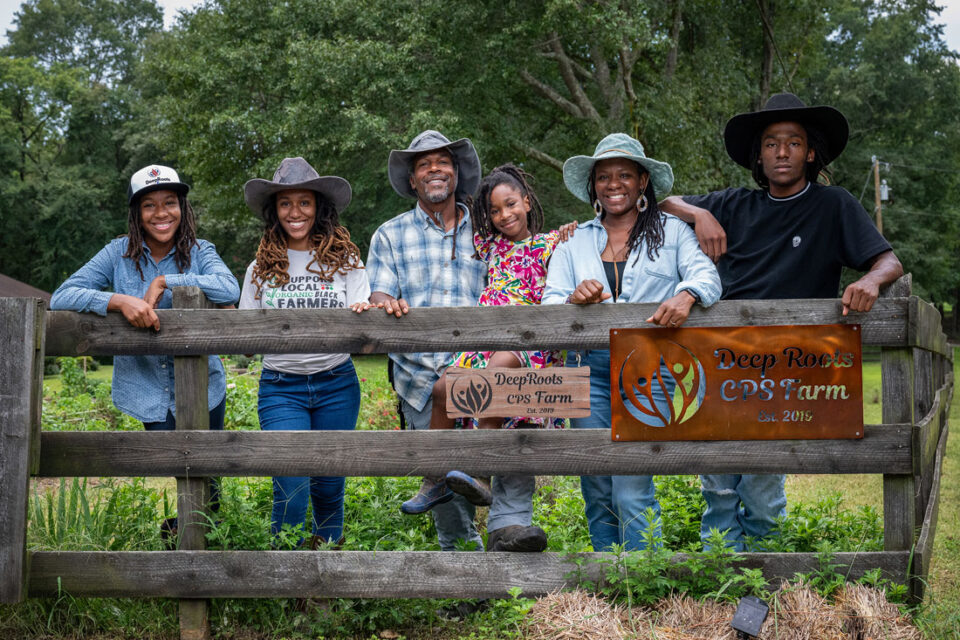
Wisdom and Cherie Jzar are meme busters.
The couple are first generation food producers with an expanding operation. They launched Deep Roots CPS Urban Farm in 2019 on a 7-acre spread in west Charlotte, an area where gentrification and food deserts co-exist. Seven years later, the Jzars are thriving. Their operation has expanded to a 44-acre spread in Monroe, nonprofit partnerships and growing agritourism.
As the number of Black farmers in America falls perilously close to extinction, the Jzars are a home-grown exception.
“We started as homesteaders” in 2003 in the Coulwood community, Cherie said. “Basically, we grew food for our family. We raised some chickens in the backyard. We did beekeeping. And of course, when you start growing food, you’re going to grow in abundance. You’re going to grow more than what your family can sustain or need, and you’re going to share it with the community. That’s just a natural part of it, especially if you’re in a community like a neighborhood that we were in.
“We grew more and our yard became a place where we welcomed people and taught or shared what we were doing there, and then we took it a little further.”
Said Wisdom: “We see the need – it’s so great in our community, for Black farmers, for Black people, to be a part of food production and not just the food service industry. Our goals are lofty, so we do value where we’ve come, but we also have ideas and ambitions and goals that go beyond where we are.
“We are grateful that we’ve come this far and every once in a while, we get a chance to say, ‘Wow, we’ve come this far,’ but our main focus is to say, ‘OK, next steps.’”
Urban county, forgotten industry
Agricultural production is far from Mecklenburg County’s top industry – multi-billion financial services and energy corporations dwarf farming – but everybody eats. And small family farms like Deep Roots occupy an important niche – direct-to-market access for people who may face barriers to healthy foods.
To spur more output, local government is taking steps to help farmers. Mecklenburg County last year established a Voluntary Agricultural District program to preserve farmland and support food producers. The creation of such districts and enhanced VADs, decrease the likelihood of legal disputes between farm owners and their neighbors, and increase protection of farmland from non-farm development.
“We have over 10,000 acres of agricultural land remaining in Mecklenburg County, including horticulture, livestock, and forestry,” Erin Stanforth, Mecklenburg’s sustainability and resiliency manager said in a statement. “The Voluntary Agricultural District ordinance provides farmers a stronger voice in county government to help them advocate for themselves and the agricultural community.”
The ordinance includes 10-year conservation agreements between the landowner and county that prohibit nonfarm use or development. Mecklenburg farmers can apply for the program, which is administered by the Mecklenburg Soil and Water Conservation District and supported by North Carolina Cooperative Extension.
The county also established an Agricultural Advisory Board made up of residents who are actively engaged in agriculture. The board considers agriculture district applications; conduct hearings on public projects that propose to condemn or rezone enrolled parcels; and advise the county on local agriculture issues.
Higher tariffs, dwindling support
The federal government has long been the largest supporter of agriculture programs, but it has a checkered record when it comes to Black people. In the past, U.S. Department of Agriculture denied loans and support to farmers based on race and the second Trump administration’s campaign to dismantle initiatives has cast uncertainty over their sustainability.
Trump’s tariff program has raised the price of imported materials from fertilizer to steel that are essential to food production. Rollbacks of food assistance programs not only increases barriers for consumers, but international buyers also pass on U.S. products, further reducing farmers’ bottom line.
“A great example of this is with soybean market, which I know is big in North Carolina,” said Gbinga Ajilor, chief economist at the Washington, D.C.-based Center on Budget and Policy Priorities and a USDA senior advisor for rural development during the Biden administration. “Because of the trade war with China, China just actually stopped purchasing soybeans for a couple months. Very difficult for farmers.
“Even though there’s a so-called deal now that China agreed to, it’s still different than what they’ve been doing the past couple years. When they stopped purchasing from the U.S., they started purchasing from Argentina. Now you have these soybean farmers competing with Argentina, and they had already also been competing with Brazil from the first Trump administration. So, you have a lot of those issues that’s been happening, hurting farmers here, and it’s always the smaller, medium sized producers that get impacted.”
Retaliatory U.S. trade policy could devastate North Carolina’s food producers and the state’s economy. A report published earlier this month by the Raleigh-based John Locke Foundation estimates that reductions in agricultural exports could cost North Carolina farmers roughly $695 million — or a third of the state’s average annual net farm income.
The conservative-leaning think tank’s report, authored by North Carolina State University researcher Jeffrey Dorfman, found a trade war would wipe out nearly 3,000 jobs in agriculture and forestry as farmers respond to falling prices and lost export markets by reducing production. Job losses in related industries like transportation, food processing and manufacturing would bring the statewide total to roughly 8,000.
The peer-reviewed study identified pork, cotton, tobacco, and sweet potatoes as commodities most at risk due to their reliance on international markets and sensitivity to price declines when foreign demand falls.
“When agriculture is targeted in international trade disputes, North Carolina is especially vulnerable,” said Donald Bryson, president and CEO of the John Locke Foundation. “This report shows that the costs are not abstract — they mean lost farm income, lost jobs, and real harm to rural communities.”
When indirect effects are included — such as reduced spending by farm families and less activity in processing and manufacturing — the report estimates total economic losses of up to $1.9 billion, which equals 2% of North Carolina’s gross state product.
As USDA starves states and municipalities of funding for initiatives like the Supplemental Nutrition Assistance Program, food access is more challenging for seniors and the poor. Those decreases, coupled with new trade barriers, left producers of all sizes scrambling.
“Under the Biden administration, it was more of the understanding that there was a deep need and trying to meet those needs,” Cherie Jzar said. And then when [Donald] Trump came in office, that shifted. It shifted a lot because the tariffs and the impacts to some of the larger farmers, or commodity farmers, when the markets were cut off, specifically, the soybean market … because China decided they weren’t going to purchase U.S. soy, there wasn’t a market for a lot of the soybeans that were being produced in the United States.
“North Carolina has a large number of farms who are producing soy, and so lots of those larger farmers were concerned about where their soybeans were going to be sold.”
Changing with the times
To mitigate the impact of change, farmers like Joseph Fields have adjusted their business model.
A third-generation producer in John’s Island, South Carolina, he’s lived through decades of transition on the 80-acre spread his grandparents bought in 1903.
“It started with organic fertilizer, like spreading chicken manure and horse manure after that; from horse and plow to one tractor,” he said. “Then we would start using commercial fertilizer, and we started growing from there. Plant different products, cabbage, collards, corn, sweet potatoes, okra, green beans, a lot of variety of stuff.”
Fields, who grows corn, soybeans and wheat, has adopted a direct-to-consumer approach. With that change, new challenges emerged.
“We do a farmers market,” he said. “People are looking for organic stuff. I went to a conference in Santa Cruz, California for two weeks to learn about organic farming and … the farm is totally organic now, but at that time, it’s hard to find organic chemicals to spray your stuff with. I’ve been using household stuff to control the bugs and the disease.”
As a certified organic farmer, Fields said his business responsibilities have changed – primarily keeping records required to maintain his status with government rules. Balancing production and regulations can be a hassle.
“Well, it gets a little difficult,” he said. “A lot of paperwork – you put in a lot of paperwork to become certified. Paperwork gets thicker and thicker. You know, you got to keep records of what you sell and what you plant and what you harvest.”
As the largest urban area in the Carolinas, Charlotte is a ready-made market for the Jzars, where part of their mission is to bridge the gap to food access. They tap into community and nonprofit partnerships like farmers markets and grants to make it work.
“We’re direct to consumer in a lot of ways,” Wisdom Jzar said. “There was a time when there was a hold on SNAP and (Electronic Benefit Transfer) funding, we had to do some collaborations with food pantries and the Food Policy Council here and we did giveaways.
“We did a lot to try to support the people who are being affected by those changes. Now, a part of the cuts that came into the farm bill with the SNAP EBT benefits, that directly impacts us because a lot of our mission at Deep Roots is to address food insecurities, and that includes people who lack access to fresh fruits and vegetables. And a lot of times those people are the ones using Snap and EBT.”
‘Stripping away a lifeline’
Food producers are under increasing pressure to make do with less. When USDA froze funding for regional business centers earlier this month before canceling the program entirely, U.S. Rep. Alma Adams, senior member of the House Agriculture Committee, called for the Trump administration to reverse course. Killing the program will cut services to thousands of farms and food businesses.
A USDA report from 2024 found that business centers led to 2,800 individuals receiving technical assistance, 1,500 new partnerships formed by recipients, and 287 businesses reporting increased revenue.
The RFCB cuts are the latest in a string of federal program cancellations that impact farmers. The Local Food Purchase Assistance Cooperative Agreement and Local Food for Schools, which enabled local farmers to sell their goods to schools and food banks, was cancellation in 2025.
“While cost of living skyrockets and our farmers struggle to make ends meet due to the reckless trade war, the Trump administration is stripping away a lifeline to our agriculture communities,” Adams said. “Our small, mid-sized, and family farms are the backbone of our economy, but this administration has chosen to abandon them by defunding the Regional Food Business Centers.”
The difficulties family farms face from tariffs and falling support is a sharp departure from the previous administration, when USDA invested in them through program development and collaboration.
“There was lots of momentum under the Biden administration for equitable opportunities, equitable distribution of resources, and in some manner, trying to alter policy to accommodate small farmers, Black farmers who had not had always had a benefit from some of the federal government’s initiatives and policies and programs and to do a redress,” Cherie Jzar said. “A lot of that momentum, as it happened in the local area, was trying to reach Black farmers, trying to better understand what the challenges were and meet those needs.
“Once the administration changed, all of that momentum sort of went away, and so some of the programming started to focus more on what we call commodity farmers, larger farmers who aren’t necessarily producing food directly for their community.”
Ajilor believes farmers will endure and Black farmers – despite decades of indifference if not hostility from government – will ultimately be treated as equal partners in the agriculture community.
“There’s been a shift towards the industrial operations and getting larger and larger,” he said. “I think there will have to be a reckoning at some point. Farmers are really struggling right now, and they’re making their voices heard and so at some point there’s going to have to be something that changes. Now, what that means for black farmers, I’m not sure.
“I think it’s one of those things where it’s like a pendulum swing, where like the last couple of years, everyone’s complaining about equity and talking about (diversity, equity and inclusion initiatives) … and this administration has gone way too far. I think there’s going to be people who are more receptive to supporting more farmers, farmers of color, Black farmers, and I think there is a roadmap … that may not have been there before.”
