
 By Alex Bass
Alex.bass@triangletribune.com
DURHAM – Brian Curry had some familiarity with the family tree in the souvenir program commemorating the 110 enslaved persons who departed on Nov. 1, 1844, on the Stagville Trek to Greensboro, Alabama.
“You tried to hold us down,” Curry said. “But we’re back. It’s a whole different scenario.”
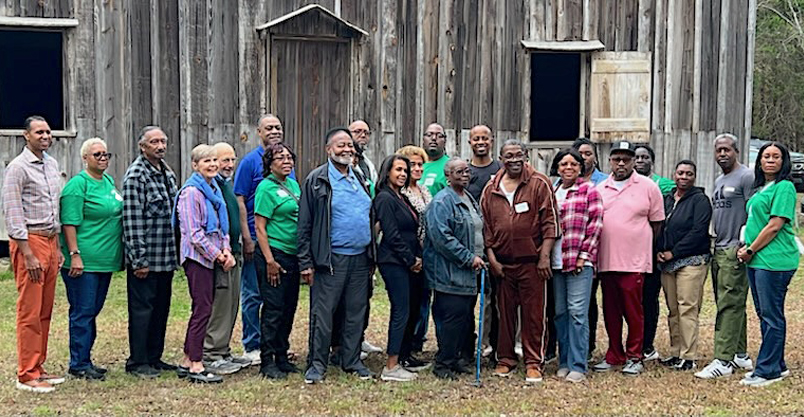
Curry was among approximately two dozen of those descendants who gathered at the Stagville State Historic Site Nov. 2 as part of the inaugural Stagville Trek reunion of the Jefferson, Hargress and Cannon families. Freed Blacks were acknowledged by U.S. President Ulysses S. Grant as integral voters who helped the previous Union Army general to win the 1868 election. Ulysese Jefferson is among the family members’ most ardent lineage research proponents.
The gathering included guided tours of the Horton Grove slave quarters and a ceremony honoring the original enslaved pioneers. A scholarly presentation by Duke professor emeritus Sydney Nathans connected what descendants saw and heard with Nathans’ Trek research read in his book, “A Mind to Stay: White Plantation, Black Homeland.”
“They stole your labor, but they kept you together,” Nathans said of Stagville planter Paul Cameron and his family. While some family units were preserved, economic opportunities led to multiple migrations after 1844 in pursuit of cotton profits. Thirty-five slaves traveled from Alabama to Tunica County, Mississippi, in 1856. Additional slaves hiked from Stagville to Tunica County in 1860. Movement among the three states’ plantations was common.
The 1860 election of Abraham Lincoln as president, and the Union Army winning the Civil War in 1865, from which slaves were emancipated, laid the foundation for Paul Hargress and his wife, Dicey to leave Stagville to return to Alabama. Cameron expelled Black workers from Stagville after the 1866 harvest.
“He agrees to go to work but not to sign a contract,” Nathans said of Hargress. “If you sign a contract, then you’re bound up for the whole year. He modeled hard work. He got other people to work hard for him. It fit for a time.”
The lasting legacy, Nathans continued, was Hargress’ North Carolina eviction precipitating his Alabama emancipation. Hargress requested that Cameron sell an acre of land to the now freed slaves to build a school and church. Cameron refused, but later in the 1870s, he sold all the Alabama parcels of land to Black people who established roots there. Hargress had 100 acres, which are still owned by Jefferson, Hargress and Cannon descendants. “They probably don’t know I have all those records,” genealogist Myles Caggins Jr. said. “I know who is paying taxes on that.” The value of land ownership, Nathans said, transcends any measure of the gold coin Hargress might have received from the Cameron family for 25 years of enslaved labor. “Land possession meant self-possession. You didn’t have to become a tenant or a sharecropper. You didn’t have to defer to a white boss man,” Nathans said. “It was the duty of the generation that inherited land from their forebearers to hold on to it. Not just for themselves, but to hold on to it for those who joined the great migration of the 20th century.”
In 1899, a landowner yielded one acre in Greensboro on a property known as Cassimore for a church and school. Nathans visited the property in 1978. In his earliest research, Nathans met Alice Hargress, another descendant and Greensboro historian who befriended him and helped expand his inquiry networks.
Hargress, who died in 2014 at age 99, was funeralized at Cassimore African Methodist Episcopal Zion Church and buried in Cameron Cemetery. Before her death, she saw several of her children who migrated northward return home to Alabama.
Jannette Parker, a Hargress descendant from Greensboro now living in Virginia Beach, returned to her hometown for a reunion last summer, and visited the landmark school and church campus. “Even through their suffering,” Parker said of her ancestors, “we are a people who, still, are able to rise above everything. I wanted to get away. Now, I know the valuable experience of always being able to go back home.”
Curry, meanwhile, was eager to do just that. “There’s still some research I have to do,” he said.
