
Herbert L. White
THE CHARLOTTE POST
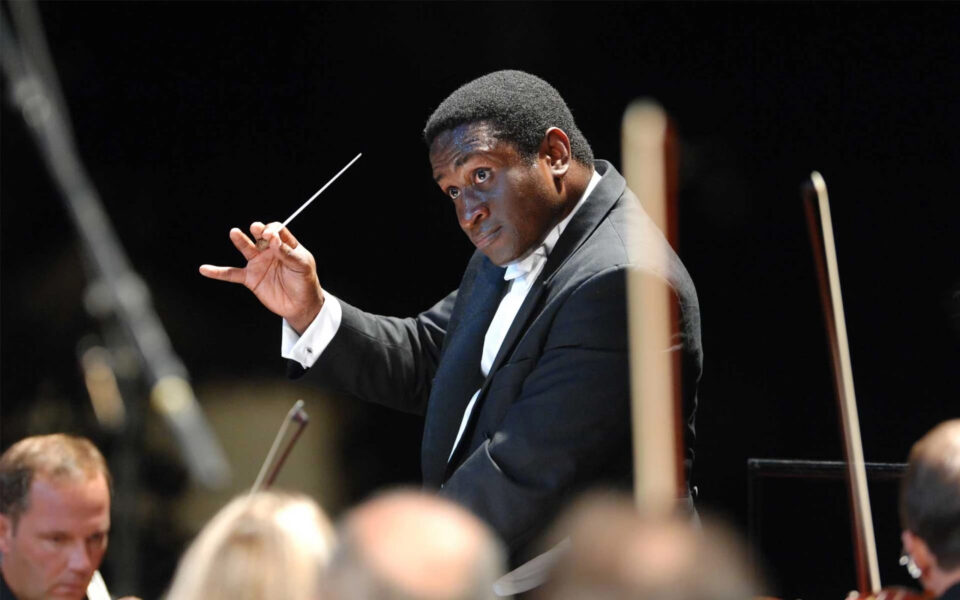
Kwamé Ryan is literally and figuratively on top of the opera world.
Ryan, Charlotte Symphony Orchestra’s music director, reached the pinnacle of his profession last week when he earned a Grammy Award for best opera recording with “Intelligence,” recorded in 2023 with the Houston Grand Opera. In an interview with The Post, Ryan, the first CSO conductor to win a Grammy, discussed the thrill of winning music’s biggest prize, the significance of “Intelligence” from a cultural standpoint and whether the award changes his professional prospects.
Answers are edited for brevity and clarity.
Immediate emotions after winning:
Ryan: I feel on top of the world. I’m really still basking in the glow … it happened to me, and I was there to experience it, which was not self-evident, believe me.
Expectations once the program started:
Ryan: Well, I was delighted to be nominated. One of the things that you notice when you’re sitting in the ceremony, which is a very long event – it’s perhaps four hours long – is that everybody who’s nominated is working at the top of their game and is worthy of a win in some sense. Second thing you notice is that there are five nominees, which means that you have a one in five chance of winning it and that kind of manages your expectations automatically. Those two things together manage your expectations, so when they get to your category, and they list off the nominees, all of whom are amazing, and then they say, ‘and the Grammy goes to,’ your heart stops a little bit.
My heart skipped at least two beats before they said the name of our project, ‘Intelligence’ and then the adrenaline hits like a like a hammer, and then you’re really on a kind of nervous autopilot until you get back off the stage.
How the winning project – based on a true story – came about:
Ryan: It was developed like pretty much any other opera. Opera is a complex art form that involves lots of different disciplines and creatives from many different fields. The orchestra, the cast of singers on stage, and then set design and construction, costume design and construction lighting. So, there’s a lot of people that need to be coordinated into the creative space at the same time.
Two years in advance, I knew that they wanted me to be on this project. Houston Grand Opera was interested in having me lead this project musically. I accepted without even having seen the score, because it wasn’t finished yet Jake Heggie and Gene Scheer was still writing it at that point, but I was so taken with the story, this true story of a wealthy abolitionist, Elizabeth Van Lew, whose family had owned slaves, who during the Civil War, created this spy ring against the South, and her prime agent was a former slave, Mary Jane Bowser, who was secretly educated and also had a photographic memory.
Mary Jane Bowser infiltrated the Confederate White House as a servant, and while she was cleaning and looking after kids, she was reading documents, memorizing them, and sending information back to the Unionists. I just think that’s a story that reads like a thriller. That’s a movie script for me.
On whether winning the Grammy carries more weight given “Intelligence’s” intersection of race, politics and espionage:
It does in some ways. I mean, a Grammy win is an incredible moment in anybody’s career, regardless of what the project is. But what I find exciting about this particular win for this particular project is that the broad exposure that Grammy win for the project that goes way beyond the normal boundaries of the classical music interested public is well placed on ‘Intelligence,’ because ‘Intelligence’ is a project that, in itself, is so accessible and so rhetorical and so relevant to where we are historically today, even though it’s a period piece, but the themes that it tackles are very contemporary. So, I’m happy that this particular project that’s so rhetorical and so accessible is getting this kind of exposure and coverage.
Immediate reaction from friends and supporters around the world:
It’s like nothing I’ve ever experienced before. You speak about the phenomena, you know, the phenomenon of phone blowing up. We use that turn of phrase [but] had never actually experienced it, to have your phone going off constantly for a number of days is something that’s quite new to me.
But what I loved, and continue to love about the experience, because my phone hasn’t stopped since the Grammy win, is that we all have people who orbit our lives at different proximities. They may be close family, close friends, but then there are colleagues, ex-colleagues, people who are who have followed our work but aren’t even personally known to us. All of these satellites that have been orbiting my life, many of them unseen from my perspective, suddenly came into sharp focus, and I was just bowled over by wave after wave of love and support that’s been coming since the ceremony, and you talk about a blow after an event like this, it really does feel like a blow that I’ve been in ever since.
If winning a Grammy ever on the career radar:
When I was a boy, I knew that there was a thing called a Grammy Award. But at that time, maybe because the classical Grammys are not carried live the way the pop Grammys are. I didn’t even know that there were Grammys for classical music, so I only discovered that once I became part of the business … but it never occurred to me that I would ever be nominated for one, and the idea that I would actually win one wouldn’t have been further from my mind.
What’s next:
One of my colleagues from the Academy for the Performing Arts in Trinidad asked me that. He was like, ‘Now you’ve climbed this mountain, you won a Grammy, what’s the next mountain to climb?’ I said to him, ‘The strange thing is, I don’t feel like I’ve been climbing anything. I feel like I’ve been doing something that I that I love; that I wanted to do. Ever since I was a boy, I’ve been privileged enough to get to do it at the highest level and privileged enough to be honored with this award. But it doesn’t change anything about how I do my work.
I still am going to be looking for projects that make me curious and make me enthusiastic and joyful in the execution, because that’s what it takes to work at this level, but it’s what I’ve been doing to date. And as they say, ‘If it ain’t broke, you don’t fix it.’
