
By Mia Khatib
mia.khatib@triangletribune.com
DURHAM — Developers Sterling Bay and Acram Group updated Durham residents Aug. 2 on their plans for the redevelopment of Heritage Square. The 10-acre site will include space for retail, on-site parking, residences, community gathering, offices and life sciences laboratories.
Sterling Bay Director of Diversity and Strategic Development, Keiana Barrett, said they want to enhance economic mobility for residents in the Hayti community and have incorporated resident feedback into their site plans.
“We cannot do this work well in isolation,” she said. “We want to build off the assets that are here in this community and make sure that this development is one that is formed to bring about meaningful growth for this economy and community.”
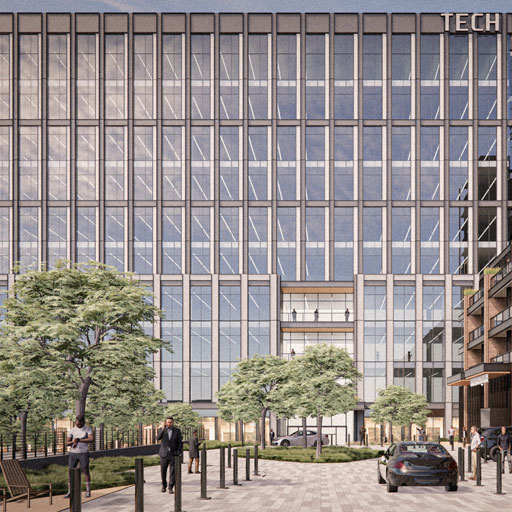
Phase 1 of 3 will include two buildings — a 13-story residential building paralleling Fayetteville Street and an 11-story commercial and office space paralleling NC Highway 147 — that will frame a pedestrian promenade. The main entry will be off Lakewood Avenue.
The development team completed the schematic design and will present site plans to the city this month. They are undergoing traffic impact studies and expect to break ground next year.
“We’ve run a number of studies on how we can make sure that everything is self-contained and it won’t be a burden to the neighbors,” Acram Group Managing Director Aaron Lazovik said. “[We’re] really trying to build with the community instead of imposing on the community in terms of size and scale.”
In an effort to generate economic opportunities for locals, Sterling Bay is extending its annual summer internship and scholarship program to North Carolina Central University students. Barrett also said their general contractor, Brasfield & Gorrie, is partnering with a Black Durham-based general contractor, and they will include bid opportunities online for other local businesses.
In the past decade, Brasfield & Gorrie has seen an average of 20% Minority and Women-Owned Business Enterprise participation in private projects with clients that have set goals across the Carolinas, senior supplier diversity manager Jessica McMahan said. And 7% to 10% regularly on average projects without MWBE requirements.
“When we’re defining the minority status, it has to be almost 100% African American because that’s what this community is,” resident Marcus Greene said. He also asked the developers how they will identify retail tenants.
Suzet McKinney, Sterling Bay principal and director of life sciences, said they don’t include large national brands in any of their retail developments. Instead, “you’ll find brands that are local to the community where the project was built,” she said.
NCCU alum Ahmed Finoh asked how they will ensure project completion and avoid blight. Many large-scale projects across the Triangle have failed because of funding concerns during later stages, he said.
“As we’re finishing Phase 1, we plan to move directly into Phase 2… We don’t plan to leave any of that fallow, just empty and as an eyesore,” Michael Cannon, Sterling Bay vice president of development services, said. “Having a large site is a luxury for the construction team, and it allows us to keep materials on-site, trucks on-site and minimize our impact to the community from traffic.”
Angel Dozier, founder of Be Connected Durham, asked about safety and walkability. Parker Poe Attorney Jamie Schwedler said the city has its own initiatives to improve walkability on Fayetteville Street, but they are monitoring it to see how their development could interface.
A Triangle realtor asked if affordable housing will be available. Lazovik said the site was purchased for market-rate housing, and Schwedler said they are more focused on building generational wealth through retail and life sciences jobs opportunities.
“For every one job that is created in the life sciences, that one job creates an additional three and a half jobs in the larger economy,” McKinney said. “And then, depending on whose report you look at, 30% to 40% of jobs within a life sciences ecosystem only require a high school diploma or GED.”
Durham native Anita Scott Neville is worried about how these plans will transfer materially to honor historic Hayti and asked if they’ve developed in similar communities.
Barrett said they are working on a project in Englewood, an African American community in Chicago’s South Side. The site was formerly a community college, and Sterling Bay leveraged a local African American sculptor to design a monument in reflection of its history.
Multiple residents raised concerns about Food World’s upcoming closure, saying the area will become an official food desert. But Lazovik said Food World’s closing was the owner’s choice, and the redevelopment will not include another grocer because of traffic concerns and additional parking requirements.
“There’s no commitment to a grocer from you guys, and we kind of got the same answer from across the street at Fayette Place,” Pete Crispell said. “That’s rough on the community because we all love our Food Lion, but it’s two miles away from here.”
Mia Khatib, who covers affordable housing and gentrification, is a Report for America corps member.
