
By Herbert L. White
The Charlotte Post
The historic Excelsior Club is beyond repair.
Shawn Kennedy’s vision is to reimagine and preserve its spirit.
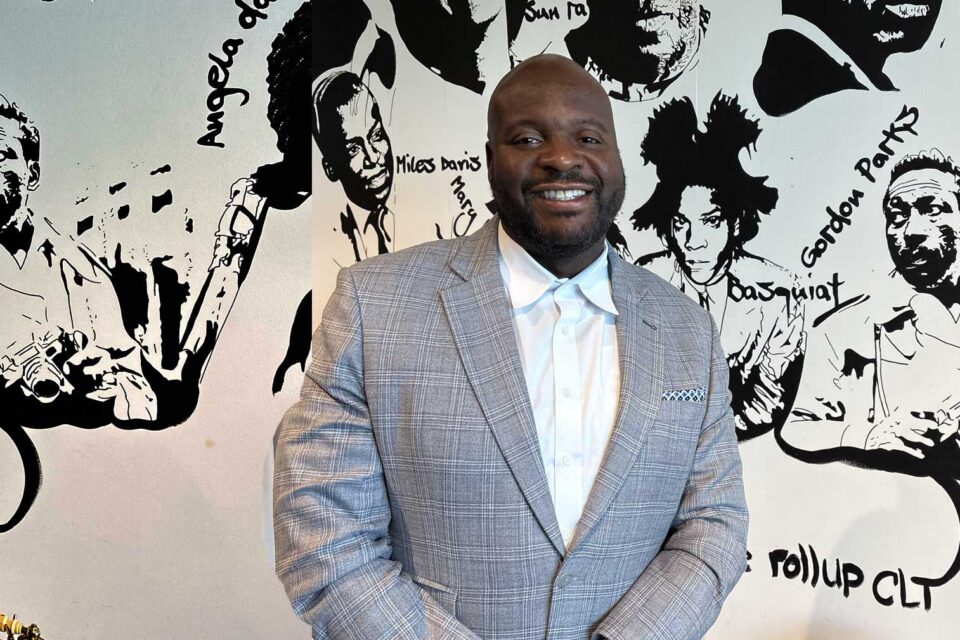
Kennedy, a Charlotte developer and partner Tim Sittema are leading an $8.3 million project to build a new Excelsior – this time as a two-story gathering space on an .84-acre site on Beatties Ford Road. Since the club shut down in 2016 due to disrepair, other developers have tried and failed, but Kennedy, a serial entrepreneur whose Kennedy Property & Development specializes in affordable workforce housing, believes he’ll succeed.
“In eight months, we’ve gotten further than anybody’s gotten in 10 years,” he said. “The difference is we’re local. We are in this community, and the last group just had a bigger project. They were doing a much larger hotel and everything else for a while. We are just coming back with Excelsior, so a lot of the obstacles they ran into – parking and all that – we’re not running into those obstacles because we’re not doing such a large project, so that’s the difference.
“But again, with anything, you’ve got to work your butt off.”
California developer Darius Anderson, who bought the foreclosed property from state Rep. Carla Cunningham in 2023 for $1.3 million, had grand plans for the Excelsior, which was founded in 1944 by entrepreneur Jimmie McKee when he converted a residential home into a social, activism and cultural hub.
Anderson, owner of Sonoma, California-based Kenwood Investments and a self-proclaimed advocate of historic site preservation in Black neighborhoods, secured financial support from the city of Charlotte, Knight Foundation and Foundation For The Carolinas as investment partners. He presented a site plan without specifics to city officials, then cited zoning rules, especially parking restrictions, with limiting his ability to proceed with a project that included a hotel.
The Kennedy-Sittema project by contrast, is more modest: event space for community meetings, outreach programs and job creation through free culinary certification training. It’ll also include a restaurant , live entertainment space and a museum.
“I’ve met so many people that had their Sweet 16 birthday in there,” Kennedy said. “Their church would meet there for events – the Easter egg hunts, the Thanksgiving dinners. There’s so many people that Excelsior means so much to them.”
That was the sentiment of Mattie Marshall, president of the Washington Heights Neighborhood Association shortly after the Excelsior was shuttered.
“We know the significance of the Excelsior Club, and we know the significance of our neighborhood, that we must preserve and protect them,” she told The Post in 2017. “I am very optimistic that we as the African American community are going to come together to seek a solution that will be in the best interest of this historic club. We cannot, as a city, dismantle and just let go of our history. It’s too important.”
The city of Charlotte and Mecklenburg County each approved $1.5 million and Kennedy and Sittema, managing partner at Crosland Southeast, have $2.3 million in owner equity. The goal is to raise the remainder from corporate and philanthropic sources.
“This is a three-legged stool,” Kennedy said. “When we came into the project, one leg is the city, one leg is the county, and the other leg is the business community and the financial community. … We have a national funder that we’ve been talking to since we acquired the property, and they let us know that we need to get at least one or two local donations, so that’s what we’re working on now.”
Kennedy and Sittema are working on a two-year window to complete funding, demolish the building and start construction.
“The timeframe is getting a capital stack together,” he said. “The big thing is we go in front of the Historical Commission on Nov. 10, and that meeting, if it goes well, that would chop a lot of time off because they have the power to have us wait a whole year before we can demo the building. We’ve been working hand in hand with them for the last six months, taking a lot of insight from them, and they’ve been very helpful.”
“I wanted to keep part of the original building,” Kennedy said. “I originally wanted to keep the facade of the building, and with the due diligence I’ve done in the building over the last few months, it can’t be done. It’s been well documented that there have been other people out there that wanted to keep from some of the facade in the building, what they were unaware of, what state that the building is in, and they have never been in the building.
“A couple months ago, I met the Mecklenburg County Historical Commission people and people from the State Historical Commission to walk the building so they could make their own assessment. And after they made the assessment, they felt comfortable with the direction we were going.”
“A lot of people need to realize the reason the Excelsior shut down in 2016 was due to needed repairs,” Kennedy said. “It didn’t shut down because of they weren’t doing financially well. They didn’t shut down because people weren’t coming in. It shut down because the repair cost was too much for that current ownership to get it done and move forward. It’s going to be a process, but I think now the community understands.”
Kennedy, who moved to Charlotte in 2006 after graduating Morehouse College, met then-Excelsior owner James Ferguson at Kennedy’s restaurant, Allure. The two struck up a friendship and Kennedy learned about the city’s – and the club’s – culture and history.
“I started becoming a frequent, frequent person at Excelsior, coming to talk to (Ferguson), and just sucking in the fish fry and taking in Dirty 30 Thursdays and seeing all the great things,” Kennedy said. “And then in that process, I learned the history at Excelsior, what it meant to the community from him and everybody else in there and the energy in it, and then 2015 when he was leaning towards moving on, I was one of the few people that he asked to purchase it.”
And in a full-circle moment, Kennedy is close to realizing the proposal he passed on a decade earlier. There’s risk, but Kennedy, who has developed affordable housing in west and north Charlotte, is determined to make the project work.
“You’ve got to know your roots are,” he said, “so that’s what makes this project so important, to show the kids, to show us as a community, and even show the people moving to Charlotte, that this is what Charlotte is. This is what makes Charlotte so special.”
