
Cameron Williams
The Charlotte Post
She Built This City on trade industries.
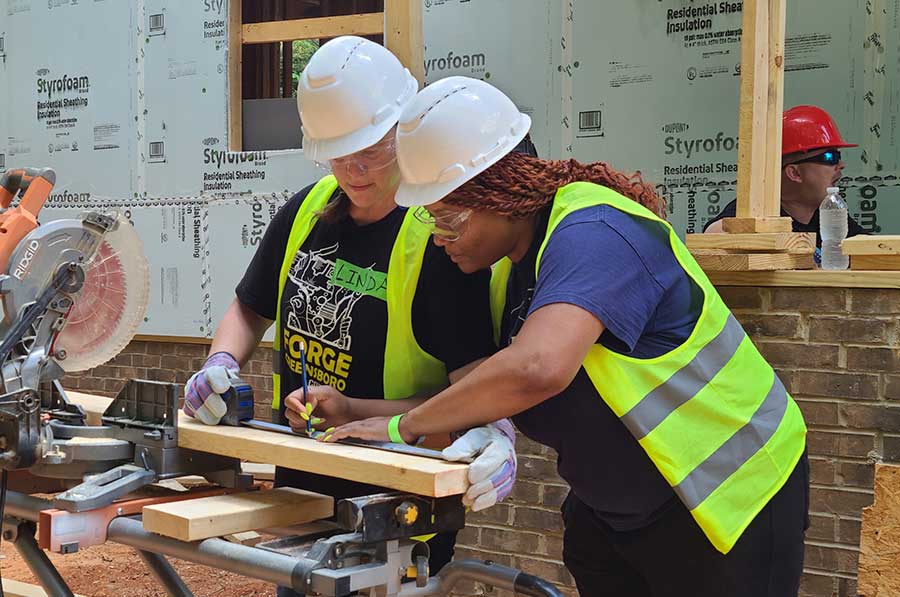
The Charlotte nonprofit’s mission is to empower women, young people and underrepresented communities in the trade work industries. SBTC provides training for skilled-trade professions in hopes of challenging the status quo in traditionally male-dominated industries.
The organization was launched in 2020. Executive Director LaToya Faustin is an advocate of diversifying trade industries and equal representation.
“In the last few years, we’ve seen that the construction industry… the people who are doing the work are aging out of the work,” she said. “And there’s no pipeline of skilled trade workers truly activated to fulfill those roles. There’s a study and it’s called Dark by 2050, and they say that the current rate that we’re going with the current electricians that we have, and the ones that are in a pipeline… We do not have enough to fulfill the needs of our country.
“By the year 2050, we will be dark, and there won’t be people to maintain the electricity and light in our country. … There is a demand for construction. Women have been disengaged for a number of reasons in the process of entering into the skilled trades, and so the mission of She Built This City is to see that change.”
SBTC has a 50/50 by 2030 initiative where the goal is to have an equal ratio of males and females in the trade industry by 2030. Faustin acknowledges it’s a lofty goal, but without it, there’s never an accomplishment.
“I call it a ‘BHAG,’ she said. “A big, hairy, audacious goal, but it was one that we set out to pursue as a goal for us as a community-based organization before the industry as well. To say we need to see equity, but it isn’t just a demand for more representation. It’s more workers, a different skill set that will be coming into the pipeline that will truly help us innovate for a future of jobs yet to be created.”
Faustin says many things need to happen to be able to achieve a goal like this like an easier access to maternity leave in trade industry jobs. Other things include childcare and personal protective equipment that is made to fit the woman’s body form and many more.
“Are we making pipelines into the industry through apprenticeships,” she said, “and I’m looking at diverse spaces of recruitment and communities and other organizations to ensure that pipeline is sound and solid. So, not just going to the same place as you’ve always gone, I’m getting more people engaged into the conversation about the trades and so that, in essence, is the pledge, is our commitment and desire, but also a call to action to the industry of saying, to be a more welcoming and inclusive space.”
SBTC recently received $50,000 in funding from the Gusto Impact Award for contributions in the Charlotte community.
“That $50,000 encompasses both a $10,000 cash gift, unrestricted, that we’ll use to train additional people in the community,” Faustin said. “The additional $40,000 is coming through advertising support. So, we have a brand-new billboard off Exit 7 on I-77, the Clanton Road exit. It represents our mission in a very robust, active campaign online through Facebook and Google, Google searches as well. This way She Built This City ads keep popping up and spreads more awareness to the work that we do.”
Faustin implores the community to get involved with the mission.
“Donations,” she said, “that is what makes things move. We can work and we get the people to do the work needed to be done. Donations are always helpful. However, in our space in particular because we are a job training program. We need employers. Small businesses, general contractors, subcontractors, plumbing, electrical, painting, carpentry and any of those trades. If you’re looking for people, we have a pipeline for you. We’re also always looking for instructors to help train the next generation.”
SBTC is in its fifth year and Faustin says she hopes in the future that it is fully sustainable with more women represented in trade industries.
“Our ultimate goal is to ensure that both She Built This City can self-perform work as well as our graduates,” she said. “And so what does that look like? We’re launching our for-profit efforts, and so we’re hiring our graduates from our program to be on work crews, and so they’re going around the city doing handy woman work within the greater Charlotte area. And then we’re graduating entrepreneurs that are launching their own businesses.
“What we’re hoping to build is an ecosystem of women and minority business owners within the trades here in Charlotte, contributing to the local economy, but then they are our future employers as well.”
